With a fast transition towards clean fuels in India, E20 petrol is soon to become mandatory at petrol pumps, and E85 flex fuel is now making its way into the market. The question is, though, what really happens to your car or bike when you fill it up with these ethanol blends?
We dealt with various tests from the industry, feedback from various manufacturers, and real-world experiences on the road to determine whether the alternative fuels, E20 and E85, were a good or bad idea for motorists.
This section explains the difference between E20 fuel and E85 fuel.
Both fuels combine petrol with ethanol, but the amount of ethanol that could be present in the fuel has a significant impact on certain things such as engine compatibility, fuel efficiency, and performance. Before understanding their real-world effects, it’s important to know what these fuel grades actually mean.
What Even? “Translate the word ‘E’.”
‘E’ stands for ethanol, a biofuel which is renewable, mainly produced from a variety of crops like sugarcane, biomass residues, maize, and agricultural waste. The figure that comes after the “E” represents the per cent of ethanol content of the fuel blend.
What Is E20 & E85?
As mentioned above, both fuels have a mixture of ethanol and petrol. For E20, the mixture of ethanol and petrol is 20% and 80%, respectively, and for E85 (also alluded to by Flex-Fuel Vehicles (FFVs)), the mixture of ethanol is 85% and the petrol is 15%.
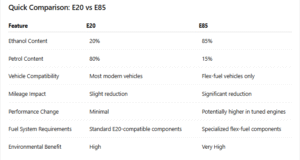
So being aware of this distinction is key before assessing its impact on mileage, performance, engine durability and overall ownership experience.
E20 vs E85: Which Delivers Better Fuel Efficiency?
When most vehicle owners consider switching to ethanol-blended fuels, often the first thing on their minds is mileage. E20 and E85 are both environmentally friendly and provide a reduction in reliance on imported crude oil, but they also have a direct effect on fuel economy because ethanol produces less energy in comparison to petrol.
Why Does Mileage Drop?
Fuel is stored with a specific amount of energy inside each litre that the engine transforms into movement. The energy density of pure petrol is greater than ethanol. The higher the ethanol content of the fuel, the less energy consumed per litre.
To run at an identical horsepower, the engine must use a bit more fuel. Imagine that a car that can travel 20 km on one litre of petrol requires a bit more fuel to travel the same distance on E20 or E85.
E20: A Small but Noticeable Difference.
Fuel with 20% ethanol, or E20, does not make a major impact on fuel economy.Under real-world driving situations, most people see a drop in mileage of 2-6%. Suppose a pure petrol car delivers a mileage of 20 km/l, and if we shift to E20 fuel, then the car would have a mileage of 18-19 km/l.
.E85: The Mileage Challenge.
The energy density of E85 is lower than petrol due to the fact that E85 contain 85 percent ethanol. Consequently, flex-fuel cars that use E85 fuel will tend to use 20–30% more fuel than those on pure petrol. Let’s take a few cases to clarify this. Suppose a car, which is running on pure petrol, delivers a mileage of 20 km/l, and when shifting from pure petrol to E85, that car would deliver a mileage of 14-16 km/l.
It could be a big drawback at first glance, but E85 generally costs less than petrol, meaning this will help to balance out the increased fuel consumption.
E20 vs E85: What Happens to Performance?
Most people, when talking about ethanol-blended fuel, concentrate on the mileage. But there are other important areas where myths and facts overlap and mix, most notably the performance area. Some automotive manufacturers have felt that ethanol leads to loss of engine performance; others have felt it enhances performance. The reality lies somewhere in between.
The Science Behind Ethanol Performance.
Ethanol’s biggest benefit is that it has a high octane rating. Higher octane fuels are more resistant to engine knocking and are capable of operating engines in a smoother and more efficient manner.
For reference:
Most standard petrol will be made up with an octane number of approximately 91 – 95, but in the case of ethanol, the octane rating is above 100. This could be especially useful for combustion quality, particularly for engines that are optimised for high-octane fuels, in situations where ethanol blends can be used.
For vehicles that are E20-compatible, performance differences are usually minimal. Most drivers detect the following under normal driving conditions: Same acceleration, smooth throttle response and same highway cruising performance, with no noticeable decrease in top speed.
Today’s engine control units (ECUs) automatically compensate for the ethanol by regulating fuel injection and ignition timing. In some instances, drivers even report slightly smoother engine operation, better cold start performance in new cars, and reduced knocking response under load.
What About Older Cars and Bikes?
Older vehicles can have another story to tell. This is because some of the vehicles aren’t calibrated for higher ethanol mixes, so there may be problems such as the following: Slower throttle response, rough idling, hesitation when accelerating, and minor power loss at high rpm. These effects are most often present in the following situations: small-capacity motorcycles, older commuter cars, and poorly maintained vehicles.
Interestingly, E85 has the potential to produce more power than petrol. Due to the very high octane rating of E85, the engine can operate at a higher compression ratio, more aggressive timing, and increased boost pressure from a turbo. Thus, many race teams and performance enthusiasts all over the world are switching to high-ethanol fuels.
In properly designed engines that use flex-fuel, E85 can be used to actually provide stronger acceleration, better resistance to engine knock, and better resistance to engine knock.
Summary Regarding Performance
E20: Modern vehicles have little change in performance.
E85: Gains greater power in the flex-fuel or specially tuned engines.
Older cars: May experience slight performance loss if not designed to handle ethanol fuel mixtures
Will E20 or E85 Damage Your Engine?
A major worry for car owners is that ethanol-blended fuels can wreak havoc with the engine over time. The fortunate part is that today, all vehicles created for E20 are engineered to have ethanol-compatible fuel volumes, seals, injectors and engine components. E20 doesn’t result in any unusual wear on the engine and can be safely used throughout the use of the vehicle. In fact, ethanol simultaneously burns cleaner than regular petrol and can help to keep combustion chambers cleaner in the long term and reduce carbon deposits inside the engine.
Older cars and motorcycles, however, which were not manufactured according to the ethanol capability, might encounter a few problems. Ethanol can take up moisture from the air and can eventually cause damage to rubber hoses, seals, gaskets, and some parts of the fuel system that are made of metal. These problems typically take years to appear, but any car owner with an older vehicle should regularly check fuel-system components and follow the manufacturer’s guidelines.
Regarding E85, it’s beneficial in vehicles of dedicated flex-fuel design, with an engine that has been calibrated for ethanol and parts that are built to withstand ethanol fuel. E85 is safe and reliable in the appropriate model and type of vehicle but can cause fuel system damage, poor performance and wear in typical petrol vehicles. The bottom line is this: if your car is built for the ethanol mixture that you are fuelling it with, it shouldn’t have many problems.
My Verdict Regarding The Engine:
E20: Safe for current E20 fuel cars and motorcycles.
E85: Only safely used in properly designed flex-fuel vehicles.
Older vehicles: May need more surveillance on fuel lines, seals or metal parts.
In fact, ethanol won’t make engines automatically fail. The fuel is much less important than the compatibility. If the mix is the one your vehicle was designed to handle, long-term reliability will not be significantly affected.
How Ethanol-Blended Fuel Is Beneficial.
In addition to providing the power for your car, E20 and E85 fuels have other advantages. The ethanol made from these renewable resources, like sugarcane and agricultural crops, helps in decreasing dependence on imported crude oil and reducing the overall carbon emissions.
Furthermore, the ability of the increased production of ethanol to benefit the individual farmer and the rural industries makes ethanol-blended fuels an important factor in pursuing a cleaner, more sustainable and energy-secure future.


