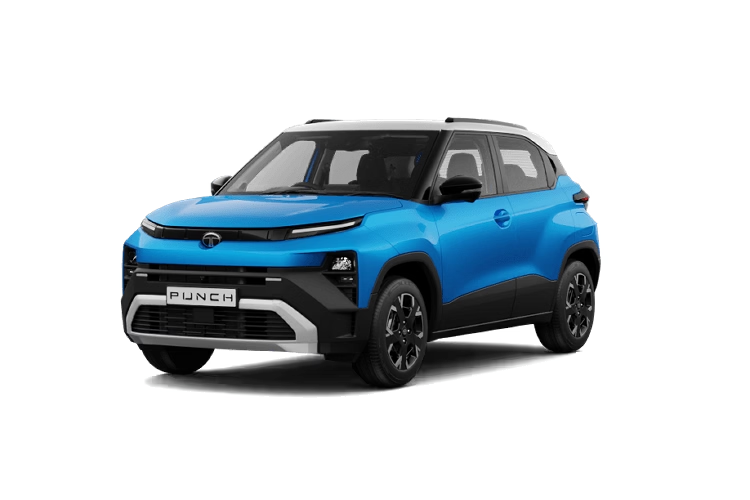
The number of EVs available in the Indian market is growing and there are several options to choose from for the customers that can be profitably owned. Of those, the Tata Punch EV and Citroen e-C3 are two practical electric vehicles that are within this budget range. Although the two cars are made for urban commuting, there are definite differences in design, cabin quality, battery technology, performance, features, and charging capabilities. The electric SUV is a vehicle you may be considering purchasing. If so, here’s a breakdown of all the necessary information to help you decide on the right vehicle for you to buy.
Tata Punch EV vs Citroen e-C3 : Exterior Front Comparison
Tata Punch EV follows Tata Motors’ new Acti.ev design principles and looks like a futuristic vehicle. On the front, it’s got the full-width LED daytime running light (DRL), split Smart LED headlamps, LED fog lamps that now have a cornering mode and a tidy closed-off grille, making it instantly recognisable as an EV. The signature lighting along with the muscular bumper and 16-inch diamond cut alloy wheels enhance its road presence and make it look more akin to a compact electric SUV than a hatchback.
The Citroen ë-C3 adopts the Citroën’s signature dual-chevron branding with the LED Vision projector headlamps, slim LED DRLs, chunky bumper, silver skid plates, roof rails and 15-inch diamond-cut alloy wheels. As a crossover, it has a very strong personality with its rugged exterior but not as futuristic or simple as the Punch EV. The Tata Punch EV might appeal to buyers who are interested in a bold and modern EV design.
Tata Punch EV vs Citroen e-C3 : Interior Comparision
The moment you step into Tata Punch EV it gives the impression of being something of high quality and technologically advanced. It features a 10.25-inch infotainment system, a fully digital instrument cluster with a 10.25-inch screen, wireless Android Auto and Apple CarPlay, ventilated leatherette seats, an electric sunroof with voice control, a wireless phone charger, air purifier, and electronic parking brake with Auto Hold, as well as a 360-degree camera and digital rotary drive selector. The design and materials on the clean dashboard gives an upscale feel that is typical of all the more expensive electric SUVs.
Instead of technology, the Citroen e-C3 makes an emphasis on comfort. It’s equipped with a leather-wrapped steering wheel, a 10.25-inch touchscreen infotainment system with android and apple car play support, premium leatherette upholstery with Electric Blue accents, an E-Toggle automatic gear shifter and connected car technology. The cabin’s spacious and comfortable layout is achieved through an industry-leading 2,540 mm wheelbase, but lacks some of the high-end luxuries found in the Punch EV, such as ventilated seats, a digital cockpit, a 360-degree camera, an air purifier, and a sunroof.
Tata Punch EV vs Citroen e-C3 : Battery Pack, Range & Performance Comparison
Tata Punch EV will have a choice of two battery packs. The version with a 30 kWh battery generates 88 PS and 154 Nm of torque, and has an ARAI-rated range of up to 375 km. With identical 154 Nm of torque, the 40kWh variant produces 129 PS but has the longer cruising range of up to 468km, which is best suited for those looking for high performance and range.
The Citroen e-C3’s battery pack consists of a 29.2-kWh lithium-ion pack coupled with the Permanent Magnet Synchronous Motor which delivers 57 PS and 143 Nm of torque. With a driving range of up to 320 km in a single charge, it is ideal for driving in cities and for short trips. This battery is also equipped with regenerative braking and LFP battery technology to enhance efficiency and long-term usability.
Tata Punch EV vs Citroen e-C3 : Charging Time Comparison
Another winning point of Tata Punch EV is its ease of charging. Using a standard 15A home socket, the 30 kWh battery takes approximately 11.9 hours for a full charge, while the 40 kWh battery requires around 14.8 hours. With the optional 7.2 kW AC fast charger, charging time reduces significantly to about 4.5 hours for the 30 kWh variant and 5.3 hours for the 40 kWh version. For faster charging on the go, both battery variants support 65 kW DC fast charging, which can charge the battery from 20% to 80% in just 26 minutes or 10% to 80% in around 30 minutes. Additionally, a quick 15-minute top-up can provide up to 110 km of driving range for the 30 kWh variant and 135 km for the 40 kWh variant.
The Citroen e-C3 supports CCS2 DC fast charging, allowing the battery to charge from 10% to 80% in approximately 57 minutes. Using a standard 15A household socket, a full charge takes around 10 hours and 30 minutes. While suitable for overnight home charging, it is considerably slower than the Punch EV during long-distance travel.
Tata Punch EV vs Citroen e-C3 : Safety Comparison
Another area where Tata has thrown in extra padding for the Punch EV is in safety. It’s already equipped with 360-degree surround-view camera, ISOFIX child seat anchors, Electronic Stability Program (ESP), Blind Spot View Monitor, Electronic Parking Brake, rain-sensing wipers and over 60 safety features and will be one of the safest EVs in its class when it launches.
Citroen’s e-C3 also has a host of safety features: six airbags, ABS (with EBD), Hill Hold Assist, ISOFIX child seat connection points, reverse parking sensors, speed-sensitive door locks, seatbelt reminders. It provides a basic safety suite for regular driving, but has a few missing advanced driver assisted and convenience features that are available in the Punch EV.
Tata Punch EV vs Citroen e-C3 : Price Comparison
Price is an important factor in the purchase. At around ₹10 lakh (ex-showroom) pricing, this Tata Punch EV proves to be one of the most value-for-money electric SUVs in India for its technology, performance, and features. The Citroen e-C3 on the other hand, begins from approximately ₹13 lakh (ex-showroom). Despite its higher starting price, it offers fewer premium features and a less powerful electric powertrain, making the Punch EV the stronger value proposition for most buyers.
My Final Word:
Both the Tata Punch EV and Citroen e-C3 are electric vehicles, but they cater to different needs. According to me i would like to choose Punch Ev out of these two because, Punch provides powerful performance, longer driving range, quicker charging, premium interior, advanced technology, and superior safety features. Overall, the Tata Punch EV emerges as the more complete and value-for-money electric SUV, making it the stronger recommendation for most buyers in this segment.


