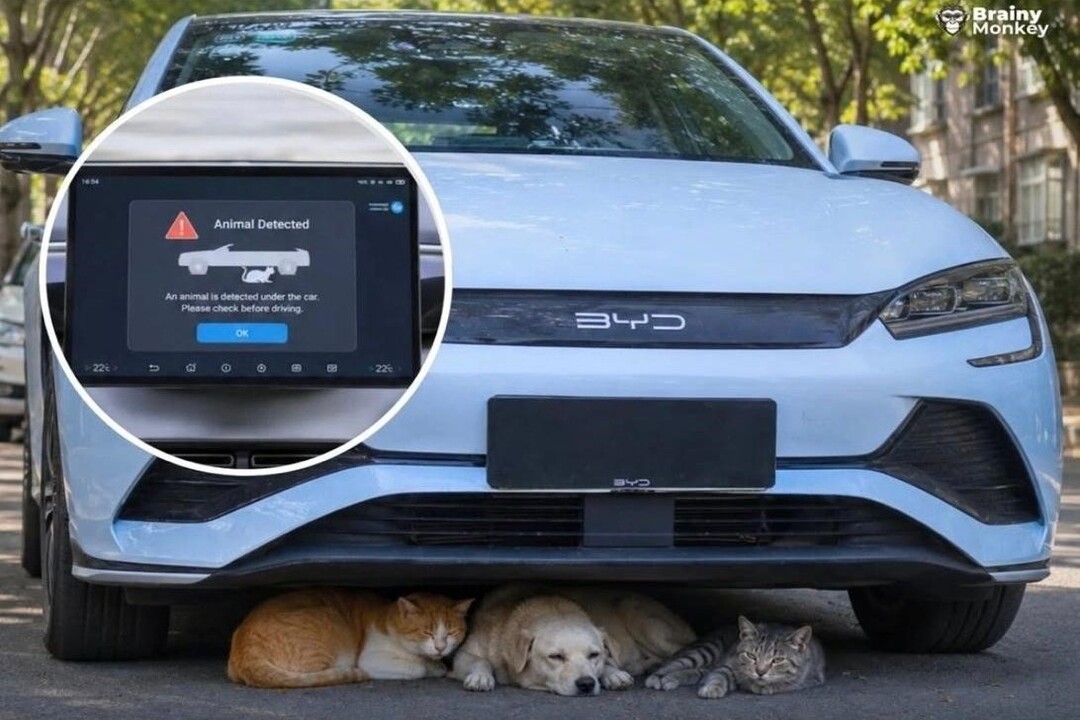
Suppose that you leave your car somewhere and go away for a period of time to attend to your work. Once back, you basically start your engine and drive away without knowing what’s under your vehicle. But what if a cat or dog is resting under the vehicle at that very moment? You might not know that an animal is there, and in less than a blink of an eye a harmless creature may die. It is a minor yet significant issue; this is exactly the kind of trouble BYD is seeking to prevent using its latest technology.
BYD seems to have an interesting suggestion for solving that issue. The Chinese carmaker has filed a patent for a new technology that is able to detect the presence of a living body under a car. The system is not dependent solely on the driver’s ability to see what’s directly in front of them or that of the standard parking sensors; it uses cameras and image processing to scan below the vehicle and look for anything that shouldn’t be in the way.
How BYD’s Underbody Detection Technology Works
In fact, BYD’s technology is very ingenious. The system is capable of taking a picture of the area under the vehicle when it is parked. This image is used as a reference of the underbody area without anything in it.
The system can also take another picture of the animal when it comes crawling under the car, then compare the original image to the current image. Any major change between the two images can then become a target for further analysis.
As simply explained, the car first learns the texture of the area below it if it is empty. Now, if someone places something there after, the car can sense their presence.
The car may be able to detect and recognize a living thing.
The technology is based on more than just object recognition. BYD’s patent explains a system that can analyze the detected target based on various points, including its location, its categories, and its degree of confidence in the detection.
This might enable the car to tell the difference between a normal object and a potential living being. For instance, an animal trapped under the car will cause a response that will differ from any object (non-living things) found only under the car.
That makes the thought particularly interesting, for the system is not merely asking, “Is anything there?” It is trying to find out—what is there?
More Than Just Cats and Dogs
Of course the first, and possibly the most obvious, who could benefit from underbody detection technology at BYD would be cats and dogs. Animals can frequently seek refuge under a car, especially in the hot summer months of India, where the shade under a car can be a lifesaver. The same area can also be used as shelter from the rain when it rains.
The biggest issue comes when the driver re-enters the scene. Sporting is difficult for a caravan that somehow got in beneath the vehicle while it was parked. A brief visual inspection of the vehicle might not detect the presence of a cat or dog lying in the center of the underbody region. This system would give animals the chance to move away before they reach the car’s door and could help to avert serious crashes if BYD’s equipment detects the live body before the car is in motion.
Believe it or not, BYD’s patent does not just apply to cats and dogs. It’s the sensing of a “living body” generally under the vehicle and thus opens up a broader spectrum of applications. The system could potentially detect other animals and, depending on its final implementation, even a person in the area underneath the vehicle.
What will happen when something is detected?
The description of the patent states that the vehicle can react to the detected situation in different ways. A warning may be issued visually, vocally, or on a connected device.
In some instances in the patent, the system even might be able to prevent a vehicle from starting until the detected living body moves out of the area under it. This might make it a more functional safety system, rather than a passive detection system.
How Could It Work at Night?
Locating an animal under a car during the day is another point. Even finding an animal under a car during the night is challenging. Doing the same thing in a dark parking area is much more difficult.
This challenge is also taken into account in BYD’s patent. If the captured picture is dark, the image-enhancing technique can be applied prior to analysis. The patent describes some noise reduction process, grayscale conversion, and image normalization process to enhance image quality.
Is BYD Making This Technology Available for Its Car?
However, not until now, at least from patent information. A technology was disclosed in BYD’s patent application, CN 122200729A; however, a patent does not necessarily mean it is confirmed that it will be included in production. Patents take place on technologies that could potentially be developed for mass production but do not always occur.
As for the model and launch date of this underbody living-body detection system, they are not confirmed at this stage. This patent does, however, provide us with a peek at what types of safety features BYD continues to look into for future vehicles, though.
Could This Become a Common Feature in Future Cars?
It certainly has potential. As cars become more connected and software-defined, manufacturers are looking beyond traditional airbags, ABS, and parking sensors. Cameras, artificial intelligence, and image processing are allowing vehicles to understand increasingly complex situations.
Having an animal come under a parked car might seem like a minor specification, but it’s a real-world issue that many typical safety features don’t account for. In the future, if BYD decides to put this technology into production, the car would essentially be making a final safety check before going on the go.
Autovenger’s Takes On This Technology:
Underbody living-body detection technology is clearly a small step but an essential real-life safety solution from BYD. Animals, especially cats, dogs, and squirrels, tend to take shelter under parked cars, and often drivers are unaware of their presence until they turn the key in the ignition of the vehicle. The camera system and image recognition that BYD uses would have the potential to alert drivers to changes under their vehicle and stop catastrophic accidents before they can happen. If the new technology is able to spot other life in vehicles’ blind zones, the technology will have more uses. At the moment it’s a patent, but it does provide a glimpse of what cars can become in the future.


