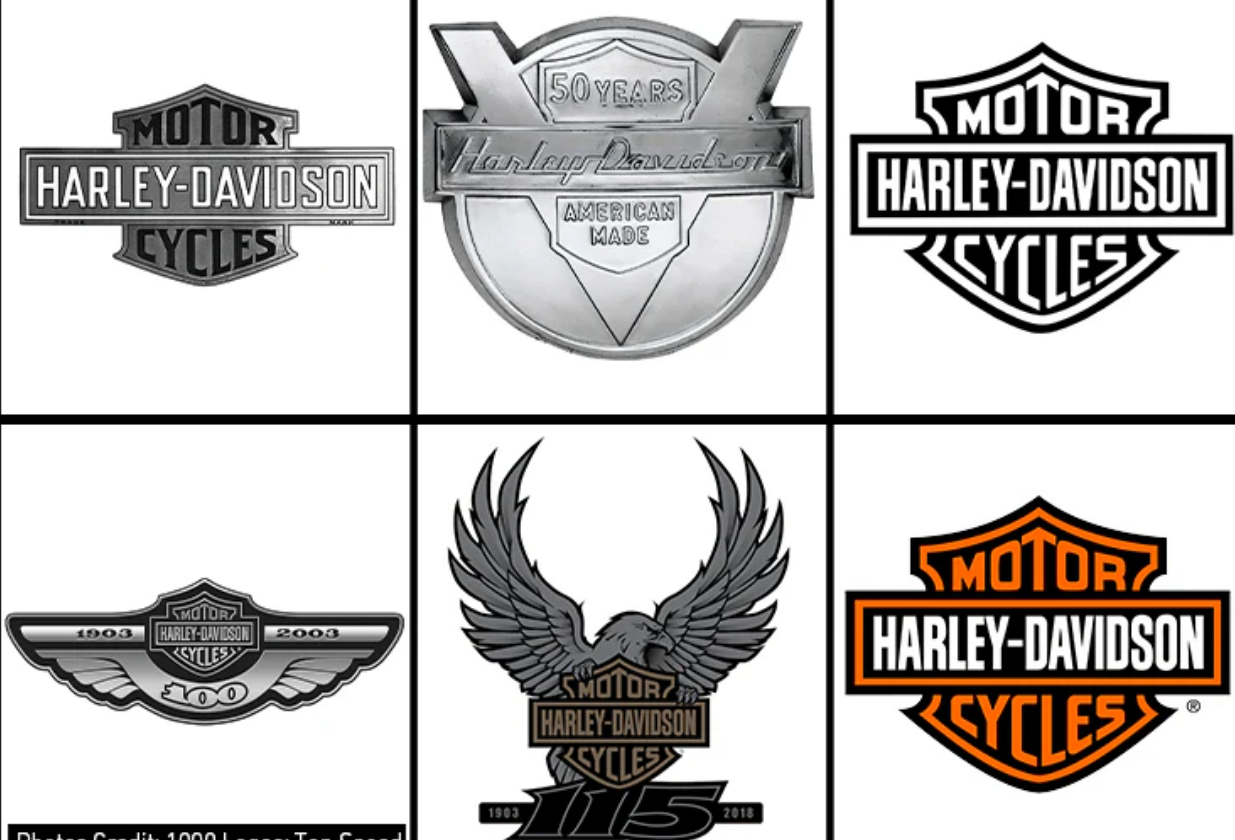
A classic symbol of freedom is the Harley-Davidson’s logo. The Harley-Davidson logo is more than just a brand name it is a universal representation of strength, liberty, defiance and the open road. For almost a century this iconic sign has represented motorcycles and a lifestyle that millions of people worldwide have embraced. From its modest beginnings in a tiny shed in Milwaukee, the Harley-Davidson logo has evolved dramatically over time to become one of the most recognizable in the world. This demonstrates the company’s cultural impact and guiding principles. This article examines the Harley-Davidson logo’s whole history and evolution demonstrating how it evolved over time without losing its essential components.
Harley-Davidson’s History: 1903–1909:
Harley-Davidson was established in 1903 by William S. Harley, Arthur Davidson and his brothers. The business didn’t do any branding or marketing at first; it just made motorcycles. At the time the official logo was nonexistent. Rather, the fuel tanks were simply rotten. The hand-painted words “Harley-Davidson Motor Company” on these early designs indicated the company’s modest size at the time. It appears that branding was not yet a major problem because there was no official logo. Nevertheless, this phase contributed to the creation of one of the most iconic automobile emblems ever.
The Bar and Shield emblem from 1910 to 1930:
Marked a change in the visual identity of Harley-Davidson. It was the first time the well-known logo was utilized. This design featured:. Harley-Davidson appears in a bar across the top. Behind it was a form resembling a shield. The shield has the words “Motor” and “Cycles” on it. This is what the logo represented. durable and robust (bar). Protect for dependability and safety.
The design was formally trademarked in 1910 after it swiftly rose to prominence as the brand’s most significant emblem. It’s interesting that despite the fact that the precise designer is still unknown, Janet Davidson, a relative of the founders is occasionally given credit for creating it. Harley-Davidson’s identity was created by this logo which continues to serve as the foundation for its branding today.
The original H-D bar and shield logo was used from 1910 to 1953
Harley-Davidson’s brand was built around the Bar and Shield logo, which was first used in 1910. It featured a sturdy bar that represented strength, resilience and trust across a shield of defense. The brand’s visual identity is still linked to this design, which gained popularity fast and remained consistent for decades.
The Harley-Davidson’s Eagle Logo from 1929:
The eagle which stands for power freedom and American pride was adopted by Harley-Davidson in 1929. Power and speed on the road were symbolized by the eagle, which was commonly shown with its wings spread. During World War II and the Great Depression this design became very popular. It strengthened the brand’s ties to the US and its sense of patriotism.
The recognizable Harley-Davidson skull emblem:
The Harley-Davidson skull logo is among the company’s most bold and defiant designs. It became well-known in biker culture and merchandise even though it wasn’t the official primary logo. The skull is a symbol for fearlessness, uniqueness and a fearless attitude. As a result, riders who value the brand edgy and unconventional image enjoy it.
The V-shaped H-D 50th Anniversary logo from 1953 to 1965:
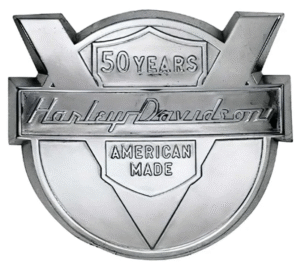
In 1953 Harley-Davidson’s created a V-shaped logo to commemorate the company’s 50th anniversary. The company’s well-known V-twin engine was emphasized in the logo. The event’s design featured large letters and a badge style that gave the impression of a celebration. It was significant because it temporarily deviated from the standard Bar and Shield design while emphasizing innovation, heritage and American craftsmanship.
The Old H-D Logo with a New Look, 1965–2003:
Harley-Davidson enhanced its iconic Bar and Shield logo between 1965 and 2003 by improving the typeface and the lines. The new design satisfied the demands of contemporary branding while retaining the original essence. It gained a lot of popularity in motorcycle advertisements and merchandise, which aided in the brand’s global expansion while maintaining its distinctive appearance.
2003: The 100th Anniversary Harley-Davidson’s logo commemorating its centennial
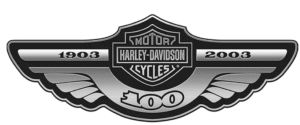
In 2003 Harley-Davidson created a unique 100th anniversary logo to commemorate a century. This design combined the traditional bar and shield with a powerful centennial motif. Metallic finishes and upscale styling were common. It celebrated a century of innovation, craftsmanship and riding culture as well as the brand’s lengthy history, global success and devoted community.
2008: The logo for Harley-Davidson’s 105th anniversary:
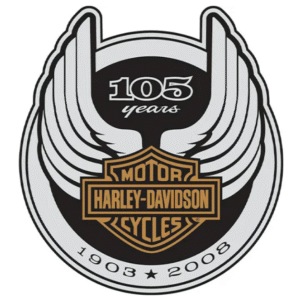
The 105th anniversary logo, which included a ribbon-style design and the Bar and Shield insignia, was released in 2008. It maintained a modern feel while showcasing celebration and legacy. The adoption of this logo at international events and protests shows how important Harley-Davidson is to the global riding community.
2018: The 115th anniversary of the Harley-Davidson emblem is celebrated:
The logo for the company’s 115th anniversary in 2018 was a bold and modern take on its identity. There were dark colors, a polished bar, strong typography, and Shield. This design honors over a century of history while also appealing to a new generation of riders by combining classic and modern styles.
Present: The Harley-Davidson logo as of right now
The present Harley-Davidson logo, which has undergone a few minor changes, is based on the original Bar and Shield design. Its lines and edges are sharper, and its formats may be changed to fit different digital platforms. This timeless emblem continues to stand for strength, freedom, and sincerity. It shows how a strong brand identity may change without compromising its core values.
The Harley-Davidson logo is very important:
- Force and Power: The horizontal bar symbolizes Harley motorcycles well-known mechanical strength and stability.
- Confidence and safety: The shield stands for two qualities that are essential for riders: reliability and safety.
- Liberty and Defiance: Over time the emblem has come to represent freedom and the spirit of the open road.
- American ancestry: The brand’s use of vivid colors and patriotic imagery connects it to American history and culture.
What Makes Harley-Davidson’s Logo So Iconic?
The worldwide recognition of the logo is a result of several factors.
Eternal Style: Harley-Davidson has remained true to its identity for more than a century in contrast to many companies that regularly change their logos.
Emotional ties: Lifestyle adventure and individual freedom are all strongly associated with the logo.
Strong devotion to a brand: Unmatched brand loyalty is demonstrated by the numerous fans who proudly display the logo on clothing accessories and tattoos.
Cultural impact: The following are linked to the logo.
- Biker culture.
- Trips by car.
- Liberty and insurrection.
In contrast to other motorcycle manufacturers, Harley-Davidson’s logo:
The Harley-Davidson’s logo differs from those of other motorcycle manufacturers for the reasons listed below. Tradition is more important than modern minimalism. Emotionally, it is different. It symbolizes a way of life rather than merely a product. While many businesses evolve quickly, Harley-Davidson’s emblem has stuck to its original design.
The Harley-Davidson’s logos’ future:
It is anticipated that Harley-Davidson will keep improving its logo without losing its uniqueness as branding trends shift toward minimalism and digital adaptability. Potential developments in the future:
- One color in several iterations
- Digital media designs that are more straightforward
- Use of legacy components in the future
It will be difficult to strike a balance between historical significance and contemporary appeal.
Concluding Remark:
Harley-Davidson’s emblem is a lasting legacy more than merely a design. From a tiny workshop in 1903 to a worldwide power, the logo has changed with the company while maintaining its essential principles. What it represents is freedom and endurance, rebellion, and the bond of fraternity. In a world where brands are always evolving, Harley-Davidson is a prime illustration of how sometimes remaining loyal to oneself is the best course of action.


